
Introduction
In today’s digital landscape, visibility is everything. Whether you’re a start up or an established enterprise, deciding between SEO and SEM for your business can shape your online success. Both strategies drive traffic, but they work differently—and choosing the right one depends on your goals, budget, and timeline.
This guide breaks down the differences, benefits, and drawbacks of SEO (Search Engine Optimization) and SEM (Search Engine Marketing), helping you make an informed decision.
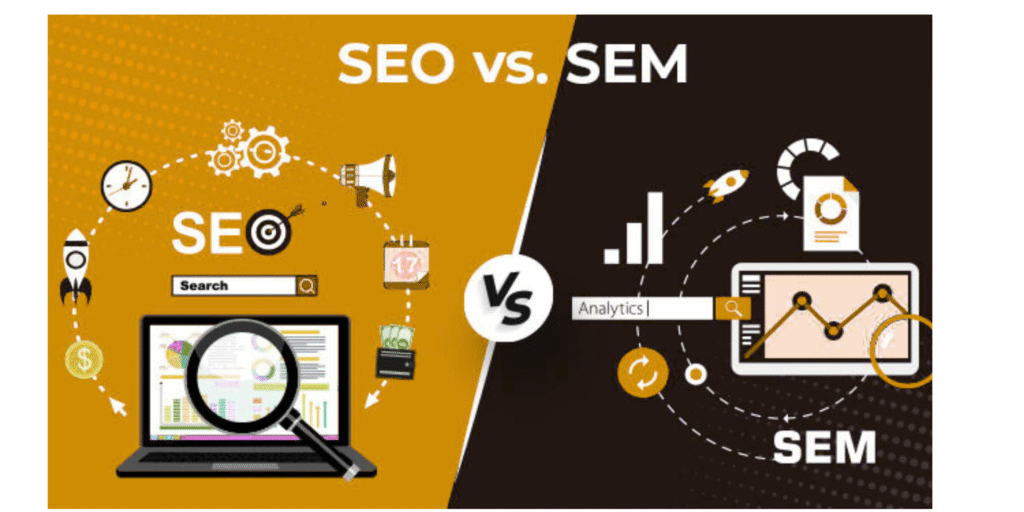
What Are SEO and SEM?
SEO: Search Engine Optimization
SEO is the process of optimizing your website to rank higher in organic (non-paid) search results. It involves:
- On-page SEO: Content quality, keyword usage, meta tags, and internal linking.
- Off-page SEO: Backlinks, social signals, and brand mentions.
- Technical SEO: Site speed, mobile-friendliness, and structured data.
Goal: Long-term, sustainable traffic and authority.
SEM: Search Engine Marketing
SEM refers to paid advertising to appear in search results. It includes:
- Pay-Per-Click (PPC): Ads on Google, Bing, or social media.
- Display Ads: Visual ads on websites and apps.
- Remarketing: Targeting users who previously visited your site.
Goal: Immediate visibility and targeted traffic.

Key Differences: SEO vs. SEM
Feature SEO SEM
Cost
Free (but requires time and expertise)
Paid (budget-dependent)
Time to Results
Months to years
Instant (as soon as ads are live)
Traffic Type
Organic, long-term
Paid, short-term
Click-Through Rate
Higher trust, lower CTR than ads
Lower trust, higher CTR with good ads
Maintenance
Ongoing content and technical updates
Continuous ad spend and optimization
Pros and Cons: SEO vs. SEM
SEO Pros:
- Cost-effective long-term: No direct cost per click.
- Builds credibility: Organic rankings signal trust to users.
- Sustainable traffic: Rankings can last for years.
SEO Cons:
- Slow results: Takes time to see significant traffic.
- Algorithm changes: Rankings can fluctuate with search engine updates.
SEM Pros:
- Instant results: Ads appear as soon as campaigns are live.
- Targeted reach: Precise audience targeting by demographics, location, and behavior.
- Measurable ROI: Easy to track conversions and adjust budgets.
SEM Cons:
- Ongoing cost: Traffic stops when ads are paused.
- Ad fatigue: Users may ignore or block ads over time.
How to Choose Between SEO and SEM for Your Business
1. Define Your Goals
- Brand awareness & long-term growth: SEO is ideal.
- Quick sales or promotions: SEM delivers immediate results.
2. Consider Your Budget
- Limited budget: Start with SEO and scale over time.
- Flexible budget: Combine both for maximum impact.
3. Assess Your Timeline
- Need traffic now? SEM is the way to go.
- Can wait for organic growth? Invest in SEO.
4. Analyze Your Industry
- High competition: SEM can help you stand out quickly.
- Niche market: SEO may be enough to dominate search results.
5. Test and Iterate
- Run pilot campaigns: Try both and measure performance.
- Adjust based on data: Double down on what works.
Best of Both Worlds: Integrating SEO and SEM
Many businesses find success by combining both strategies:
- Use SEM for immediate leads while building SEO for long-term growth.
- Leverage SEM data to inform SEO keyword and content strategies.
- Retarget SEM visitors with SEO-optimized content to nurture leads.
Conclusion
Choosing between SEO and SEM for your business isn’t about picking one over the other—it’s about aligning your strategy with your goals, budget, and timeline. For sustainable growth, invest in SEO. For quick wins, SEM is your best bet. Often, a balanced approach yields the best results.
Ready to boost your online presence? Start by auditing your current strategy and testing both SEO and SEM to see what works best for your unique business needs.